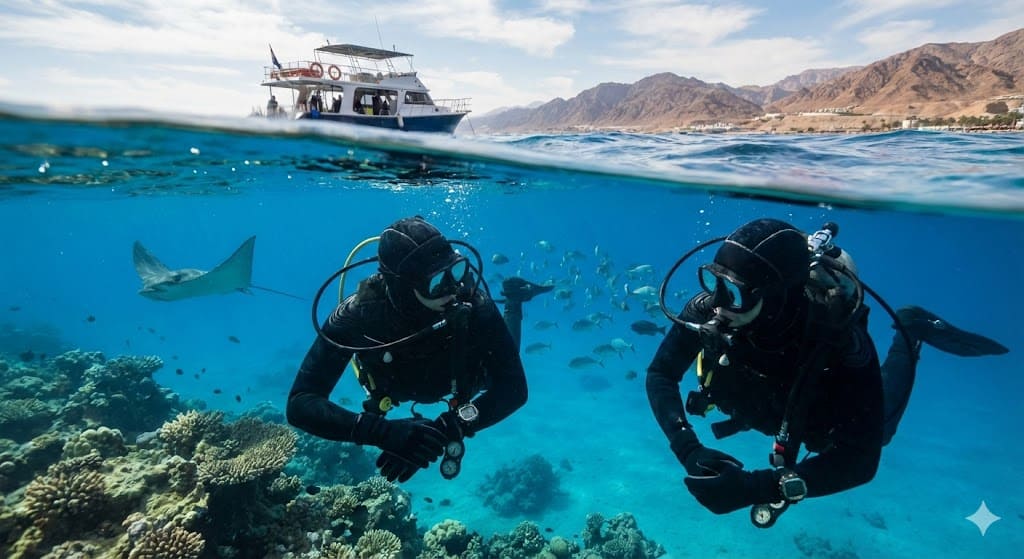
Winter Diving in Eilat
Winter Diving in Eilat: The Professionals’ Best Kept Secret
When most people envision a winter vacation in Israel, their minds immediately drift toward the snow-capped peaks of Mount Hermon, a cozy cabin in the Galilee, or a steaming bowl of soup in a Tel Aviv cafe. However, for a select group of enthusiasts and professionals, the real treasure of the Israeli winter is found at the southernmost tip of the country, beneath the shimmering turquoise surface of the Red Sea.
Diving in Eilat during the winter is a fundamentally different experience than diving in the height of summer. For professional divers, this is “the season.” For beginners, it represents a rare opportunity to learn in almost laboratory-like conditions, with surreal visibility and an underwater serenity that is impossible to find during the bustling month of August.
In this comprehensive guide, we at Nautilus Red Sea will dive deep into the heart of winter diving. We are going to deconstruct the myths about the cold, explain the biological shifts in the coral reef when temperatures drop, and provide you with the professional tools and insights needed to turn a winter immersion into an unforgettable odyssey.
The Great Myth: “It’s Too Cold to Dive in Winter”
Let’s address the elephant in the room—or rather, the iceberg in the water—right away. Is it cold in winter? Yes. Is it too cold to dive in Eilat? The answer is far more complex and surprising than you might think.
The Gulf of Eilat is oceanographically unique. While the Mediterranean Sea can plummet to bone-chilling temperatures in the winter, the Red Sea in Eilat maintains an impressive thermal stability. The minimum water temperature in Eilat stays around $21^{\circ}C$ to $22^{\circ}C$ ($70^{\circ}F$ to $72^{\circ}F$), even in the dead of winter (January and February).
Why the Water Feels Warmer Than the Air
Interestingly, because the air temperature in Eilat during winter mornings can drop to $12^{\circ}C$ or $15^{\circ}C$, the water often feels significantly warmer than the air. When you step into the sea, you aren’t shivering; you are entering a giant, temperature-controlled environment. The thermal mass of the Red Sea acts as a heat reservoir, protecting the delicate coral ecosystems from the sharp fluctuations of the desert climate.
Managing Thermal Comfort
Of course, professional diving isn’t about “toughing it out.” It’s about thermal management. With the right equipment—specifically a high-quality 5mm or 7mm wetsuit and a neoprene hood—the cold becomes a non-issue. At Nautilus Red Sea, we prioritize your comfort because a cold diver is a diver who consumes air faster and enjoys the experience less. We ensure every guest is fitted with premium gear designed to maintain core body heat for the duration of the dive.
The Visibility Advantage: Underwater Crystal
If you ask underwater photographers or marine biologists when they prefer to be in the water, the answer is almost unanimous: Winter. The primary reason is “Visibility.”
In the summer, the warmer water and intense sunlight trigger the blooming of algae and microscopic plankton. While these are essential for the marine food chain, they create a visual “fog” in the water. In the winter, this biological activity slows down significantly.
The “Gin Clear” Effect
What does this mean for you as a diver?
- Pristine Clarity: The water becomes what we call “Gin Clear.”
- Massive Sightlines: You can often see distances exceeding 30 to 40 meters.
- Deep Light Penetration: The winter sun, though lower in the sky, penetrates the clear water with sharp, dramatic rays that illuminate the corals in high-definition colors.
- The Weightless Sensation: Without suspended particles in the water, the feeling of “floating in space” is intensified because there are no visual cues to remind you that you are suspended in liquid.
For those doing an introductory dive (Intro) or taking a PADI course, this visibility is a massive psychological boost. It reduces anxiety because you can clearly see your instructor and the sea floor at all times, making the learning process much smoother.
The Kingdom Awakens: Marine Life in Winter
A common misconception is that the sea “goes to sleep” in the winter. In reality, the Red Sea remains vibrant year-round, but the cooler temperatures bring out specific behaviors and rare visitors that you simply won’t see in the summer.
The Vertical Migration
As the surface water cools, it becomes denser and sinks, causing a “mixing” effect with deeper, nutrient-rich waters. This brings certain species that usually prefer the deep, cool trenches closer to the recreational diving limits.
Rare Winter Encounters
The winter months are the prime time to spot pelagic (open ocean) animals that venture closer to the shore:
- Spotted Eagle Rays: These majestic creatures are often seen gliding elegantly along the drop-offs during the winter months.
- Large Schools of Migratory Fish: The cooler water encourages schooling behavior among various species.
- Nudibranchs: For macro lovers, winter is “Slug Season.” These incredibly colorful sea slugs are more active and easier to find during the cooler months.
- Frogfish and Seahorses: These masters of camouflage are often more visible when the reef is less crowded by summer divers.
- At Nautilus Red Sea, our veteran instructors know the secret hiding spots. Because we dive in small groups, we can move quietly and approach these shy creatures without scaring them away.
The Gear That Makes the Difference: Staying Toasty
The difference between a miserable winter dive and a dream-like experience boils down to one word: Equipment. At Nautilus, we don’t compromise. We know that if you’re warm, you’re happy.
The Wetsuit (Neoprene Science)
In the summer, a thin 3mm suit is plenty. In winter, the standard changes. We utilize full-body suits in 5mm or even 7mm thickness.
Professional Tip: A wetsuit doesn’t actually keep you dry. It traps a thin layer of water between the suit and your skin. Your body heat warms this layer, and the neoprene acts as an insulator to prevent that heat from escaping into the ocean. The tighter and thicker the suit, the better the insulation.
The Power of the Hood
This is the ultimate “Game Changer.” Science tells us that a significant portion of body heat—anywhere from 20% to 40%—is lost through the head. The head has high blood flow and very little insulating fat. By wearing a simple neoprene hood, you can stay in the water for an hour without feeling the slightest chill.
Post-Dive Protocol
The coldest part of a winter dive isn’t the water; it’s the moment you step out and the wind hits your wet suit. This is known as “evaporative cooling.” We handle the logistics to ensure you can get out of the wind and into dry clothes as quickly as possible. We also recommend a warm, sweet tea immediately after surfacing to jumpstart your internal heater.
Why Winter is Pedagogically Superior for Students
Many people wonder if they should wait until summer to start their PADI Open Water course. As a professional dive school that trains hundreds of divers annually, our professional opinion is that winter is actually the better time to learn.
Personalized Instruction and Small Groups
Eilat is a tourist magnet in the summer. Dive courses can be crowded, and the atmosphere can feel rushed. In winter, the pace of life in Eilat slows down. At Nautilus Red Sea, while we always maintain small groups (2-5 people per instructor), in the winter, you often get what feels like a private 1-on-1 experience. Your instructor is entirely focused on you, with zero distractions.
Pristine Training Sites
When you are learning to master buoyancy or practice mask clearing, you want a calm environment. In the winter, the popular training sites like “The Caves” or “The Satil” are nearly empty. There are no other groups swimming over you, and no silt being kicked up by dozens of fins. The sea is your private classroom.
Calm and Concentration
The underwater silence of winter allows for deeper concentration. Our students report feeling less “environmental pressure” and more self-confidence when the sea is quiet and unoccupied. This leads to better skill retention and a more relaxed diver.
The Physiology of Winter Diving: What Happens to the Body?
To be a truly professional diver, you must understand the physiological changes that occur when diving in cooler water.
Increased Caloric Burn
Your body works overtime to maintain its core temperature ($37^{\circ}C$) through a process called homeostasis. This means you burn significantly more calories during a winter dive than a summer one.
Our Recommendation: Never dive on an empty stomach in winter. Eat a good meal (complex carbohydrates are best) about two hours before your dive.
Air Consumption (SAC Rate)
When the body is cool, the metabolic rate can increase, and some divers tend to breathe faster. Furthermore, if you are slightly tense due to the cold, your air consumption will rise.
Our Recommendation: Relax. Use the high-quality gear we provide. The more thermally protected and “at home” you feel, the better your air consumption will be, allowing for those 60-minute bottom times we love at Nautilus.
Immersion Diuresis
This is a well-known physiological phenomenon where the body, in response to the pressure and the cold, moves blood from the extremities to the core. This signals the kidneys to filter more fluid.
Our Recommendation: Hydrate, hydrate, hydrate. Even if you don’t feel thirsty, drink water before and after your dive. Dehydration is a major risk factor for Decompression Sickness (DCS), and staying hydrated is the easiest way to stay safe.
The Nautilus Red Sea VIP Experience
Why choose us for your winter adventures? Because we understand that the joy of diving starts long before you submerge and continues long after you surface.
A Boutique Approach
As a club that has earned TripAdvisor’s Certificate of Excellence for five consecutive years, we focus on the small details. We aren’t a “factory” dive center. We are a boutique club that treats every diver like a member of the family.
Professional PADI Staff
Our team consists exclusively of veteran instructors from PADI (Professional Association of Diving Instructors), the world’s largest and most respected diving organization. Our club number is S-25559. We don’t just follow safety standards; we set them. Our instructors have global experience, but their hearts are in the Red Sea.
Premium Equipment Logistics
Forget walking long distances with heavy tanks in the wind. We manage all the logistics, transportation, and equipment setup so that your energy is reserved for the beauty of the reef.
Recommended Winter Dive Sites in Eilat
While Eilat offers dozens of sites, some truly shine during the winter months:
1. The Satil (Wreck)
This sunken missile boat is a classic. In the winter, the improved visibility allows you to see the entire 45-meter ship from the moment you begin your descent. The schools of Glassfish and Lionfish that congregate around the bridge are particularly dense this time of year.
2. The Caves
The topography of the Caves provides a natural shelter for marine life. During the winter, the play of light and shadow inside the swim-throughs is breathtaking. It’s a photographer’s dream.
3. Neptune’s Tables
For advanced divers, this deeper site offers massive coral formations that look like giant tables. In the clear winter water, the perspective of these structures against the deep blue abyss is a humbling and awe-inspiring sight.
Points for Thought: The Economic and Lifestyle Benefits
Beyond the diving itself, a winter trip to Eilat is a smart lifestyle choice:
- Luxury for Less: Eilat’s world-class hotels significantly drop their prices during the winter (excluding major holidays). You can stay at a 5-star resort for a fraction of the summer price.
- The Quiet City: No lines at restaurants, no crowded boardwalks, and a relaxed atmosphere that matches the “zen” of diving.
- Perfect Weather for Everything Else: In the summer, hiking in the Eilat mountains is nearly impossible due to the heat. In the winter, you can dive in the morning and go for a stunning desert hike in the afternoon.
Questions & Answers (FAQ)
Does it rain in Eilat, and does it affect the diving?
Rain in Eilat is extremely rare. Even when it does rain, it doesn’t affect the underwater world (the fish are already wet!). In fact, seeing raindrops hitting the surface from below is a magical sight. The only concern is rare flash floods that can cause run-off, but we simply move to sites further away from the run-off points.
Is an Intro Dive (Discovery Scuba) possible in winter?
Absolutely. In fact, many people prefer it. The personal attention and the clarity of the water make the first-time experience much more impactful. You will be with a private instructor who will hold your hand and ensure you are warm and safe.
Do I need to be a “pro” to dive in winter?
Not at all. Winter diving is for everyone. However, because the conditions are so good, you will feel like a pro because your buoyancy and navigation will be easier in the clear water.
What if I am very sensitive to the cold?
Let us know! We can provide extra thermal layers, such as neoprene vests, and plan shorter, shallower dives where the water is slightly warmer due to sun exposure.
Summary: You Owe It to Yourself
Diving is more than just a sport; it is therapy. It is the ultimate way to disconnect from a noisy, frantic world and enter a realm of blue silence. In the winter, this sense of peace is amplified. The quiet of the city, the clarity of the water, and the crisp desert air create a combination that recharges your batteries like nothing else.
Don’t let the word “winter” stop you. With the right gear and the professional team at Nautilus Red Sea, you will discover that the Red Sea is more beautiful now than at any other time of the year. Whether you want to take your first breath underwater, certify your children in an Open Water course, or explore the deep wrecks of the Gulf—we are here to provide a warm, professional, and world-class experience.
The sea is waiting. It is clearer than ever. All you have to do is dive in.